
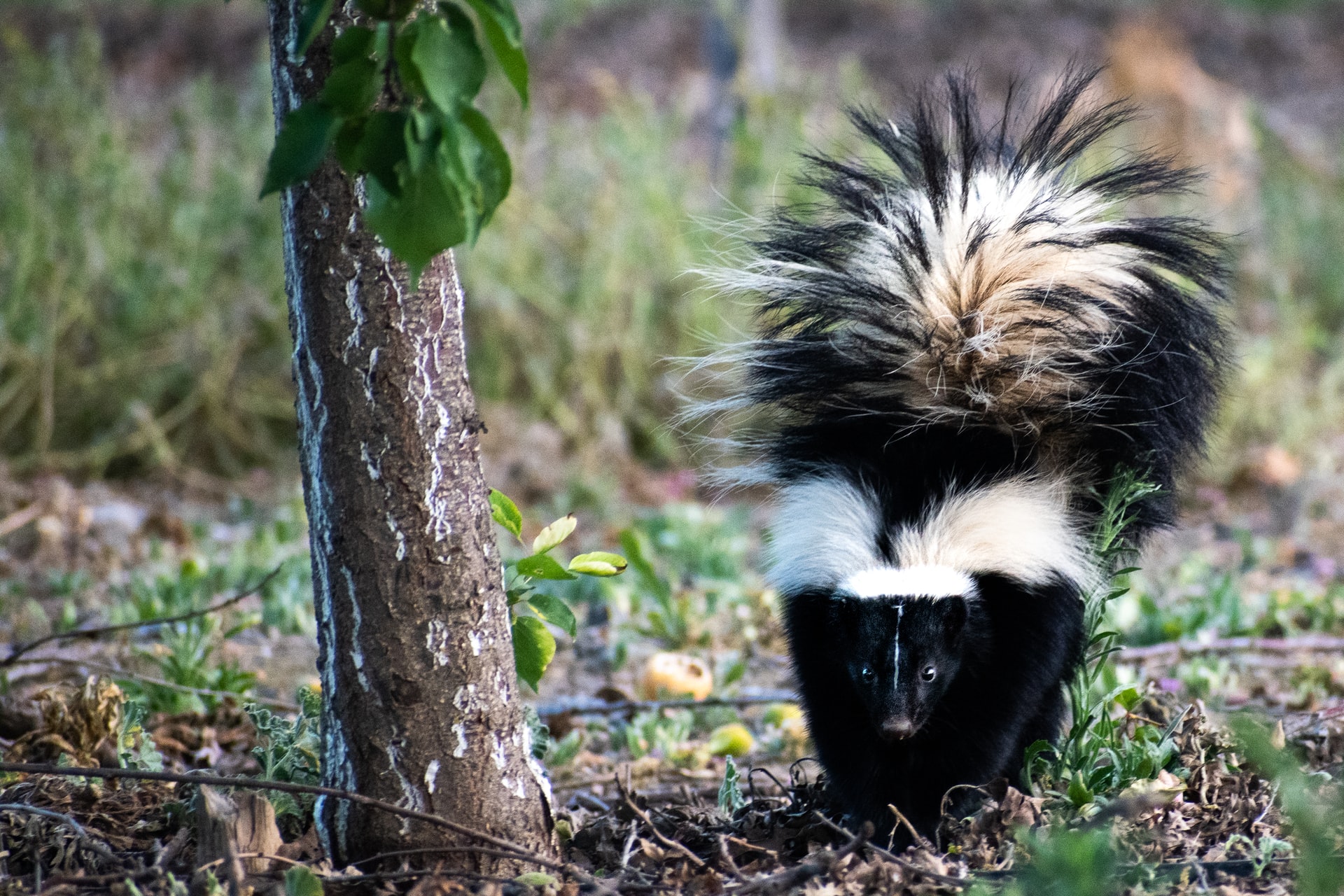
To get skunk smell off your dog, mix 1 litre (about 4 cups) of fresh 3% hydrogen peroxide, ¼ cup baking soda, and 1–2 teaspoons of Dawn dish soap in an open bowl. Work it into your dog’s dry coat, avoiding the eyes, wait five minutes, then rinse. Use it immediately — never bottle or store it. Tomato juice doesn’t work.
That’s the short version. Below is the exact recipe, how to apply it safely, why the tomato-juice myth won’t die, and when to skip the bath and call your vet — plus one thing most articles miss: a skunk close enough to spray your dog is usually living closer to your house than you’d like.
The de-skunking recipe that actually works
There’s only one home remedy chemists actually back, and it works by changing the smelly compounds in skunk spray — not covering them up. Skunk spray gets its stink from sulphur-based chemicals called thiols. Hydrogen peroxide and baking soda react with those thiols and turn them into compounds that barely smell at all. Dawn cuts the oily part of the spray so the mix can reach the fur underneath.
Here’s the formula, in the proportions that do the job:
| Ingredient | Amount | What it does |
|---|---|---|
| 3% hydrogen peroxide (the brown drugstore bottle) | 1 litre / 1 quart (about 4 cups) | Neutralizes the sulphur compounds that stink |
| Baking soda | ¼ cup | Boosts the reaction, deodorizes |
| Dawn (or any grease-cutting dish soap) | 1–2 teaspoons | Breaks up the oily spray so it can be rinsed away |
Sizing it up: That batch covers a small-to-medium dog. For a big or double-coated dog, make a second batch rather than watering it down — you need enough to soak the sprayed areas right to the skin. If you’re short on volume for a large dog, adding up to a litre of warm water helps you cover more ground without stalling the reaction.
Why you can’t premix it or store it in a bottle
This is the one safety rule people skip, so read it twice: mix it fresh, use it in an open container, and never seal it in a closed bottle. The reaction releases oxygen gas. In an open bowl that’s harmless. In a capped spray bottle or a sealed jug, that gas has nowhere to go and pressure builds until the container can rupture. Don’t make it ahead of time, don’t save the leftovers, and don’t store it “for next time.” Mix it the moment your dog gets sprayed and pour out whatever you don’t use.
A couple more cautions before you start:
- Use 3% peroxide only — the plain drugstore kind. Salon-strength peroxide is far too concentrated for skin and fur.
- It can lightly lighten dark fur if left on too long, which is exactly why you rinse at the five-minute mark instead of letting it sit.
- Wear gloves and work outside or in a tub you can rinse down.

How do you wash a skunk-sprayed dog, step by step?
Move quickly — the sooner you treat the fur, the easier the smell comes out. Resist the urge to hose the dog down first; wetting a dry coat before you apply the mix just spreads the oil around and dilutes the reaction.
- Keep your dog outside. Once that oil is inside your house, the smell moves into carpets and furniture. Do the whole bath outdoors or in a garage tub if you can.
- Check the face and eyes first. If your dog took the spray to the face, flush the eyes with cool water or plain saline before anything else (details below). The de-skunking mix never goes near the eyes.
- Mix the batch fresh in an open bowl or bucket, right before you use it.
- Apply to the dry coat. Massage the solution deep into the sprayed areas — usually the face region (carefully), neck, chest, and shoulders. Get it down to the skin where the oil sits.
- Wait about five minutes. Let the chemistry work. Don’t leave it on much longer than that.
- Rinse thoroughly with plenty of warm water until the water runs clean.
- Follow with regular dog shampoo, then rinse again. Towel dry.
- Repeat once if needed. A heavy, direct hit sometimes needs a second round. A faint whiff left after rinsing will keep fading over the next day or two, and dampness may bring it back briefly — that’s normal.
Why doesn’t tomato juice get rid of skunk smell?
Because it never neutralizes anything — it just overwhelms your nose. After a few minutes around a strong smell, your sense of smell fatigues and stops registering it. That’s called olfactory fatigue, and it’s the whole “tomato juice trick.” You stop smelling the skunk, so it seems to work; everyone who walks in afterward smells a skunk that now also smells of tomato. The thiols are still there, chemically unchanged.
The peroxide–baking soda–Dawn mix is different because it actually reacts with the smelly molecules and turns them into something that doesn’t stink. Save the tomato juice for your sandwich.
What if the skunk sprayed my dog in the eyes?
A direct hit to the face is the part that actually needs urgency. Skunk spray in the eyes causes intense stinging, redness, squinting, and heavy tearing. It’s genuinely painful but usually temporary.
Do this right away:
- Flush the eyes gently with cool water or plain (contact-lens) saline for several minutes to dilute and wash out the spray.
- Keep the de-skunking mixture out of the eyes entirely — hydrogen peroxide will only make the irritation worse. Around the face, use a damp cloth and go carefully.
- Watch for improvement. Most dogs are visibly more comfortable within an hour or two.
If your dog keeps pawing at the eye, holds it shut, or the redness and cloudiness aren’t easing up, that’s a vet call — read on.
When should I take my dog to the vet?
Most skunk encounters are a smelly nuisance, not an emergency, and the bath handles it. Call your vet or an emergency clinic if you see any of these:
| Sign | Why it matters |
|---|---|
| Eyes still swollen, squinting, or cloudy after flushing | Possible corneal irritation that needs proper eye treatment |
| Vomiting, drooling, retching, or pawing at the mouth | Your dog likely got spray in the mouth and swallowed some |
| Pale gums, weakness, dark or reddish urine | Rare, but a heavy dose of thiols can affect a dog’s red blood cells |
| Your dog was bitten or scratched by the skunk | A wound is a rabies question, not just a smell one — see below |
On rabies: skunks are one of the wildlife species that can carry rabies in Ontario. A spray isn’t an exposure, but a bite or scratch is. If your dog was bitten or scratched — or you find a wound after the fact — call your vet promptly. They’ll advise on a rabies booster and whether the incident needs to be reported, especially if your dog isn’t current on shots. When in doubt, make the call.
Your dog got sprayed because a skunk is living nearby
Here’s the part most “how to de-skunk your dog” articles leave out. Dogs get sprayed in their own backyard, usually at dusk or after dark in spring and fall. A skunk relaxed enough to wander your yard on a regular schedule is almost always denning close by — under a deck, porch, shed, or backyard structure.

If this is the first time, it may be a one-off passer-through. If it keeps happening, the skunk has a den, and no amount of dog baths fixes that. A few things to check:
- Look for a burrow — a softball-sized hole with a well-worn path, often at the edge of a deck, shed, or foundation.
- Cut off the food. Secure garbage, bring in pet food at night, and clean up fallen birdseed and fruit. Our guide to natural skunk deterrents worth trying covers the DIY options.
- Don’t seal a den in spring or early summer — you can trap a mother’s babies inside. Timing matters, and getting it wrong makes things worse. Our walkthrough on getting rid of skunks under a deck covers the entry points, deterrents, and trapping options.
If the skunk keeps coming back, humane removal is the real fix. Our usual approach is a one-way valve at the den entrance — the den checked for kits first, then the family let out and kept out, and the entry sealed afterward to help keep the next skunk from moving in. In the rare case a skunk has to be trapped, Ontario rules allow it to be relocated only up to one kilometre from where it’s caught, so it’s worth having someone who knows the regulations and does it the right way. You can see how we handle it on our skunk removal in Ontario page.
Frequently asked questions
Can I use this recipe on my cat too?
Yes — the same peroxide, baking soda, and Dawn mixture is safe for cats when used fresh and kept away from the eyes. Cats are less likely to get sprayed since they’re quicker to back off, but the recipe and rules are identical. Rinse very thoroughly and keep your cat from licking its wet coat until it’s fully rinsed, since cats groom far more than dogs.
How long does skunk smell last on a dog if I do nothing?
Weeks. Untreated, the oily spray clings to fur and flares up every time your dog gets wet or warm — sometimes for a month or more. Treating it the same day with the peroxide mix is what actually shortens it to a day or two.
Why does my dog still smell a little after the bath?
A faint whiff after rinsing is normal, especially from a direct hit, and it keeps fading over a day or two. Dampness can briefly bring it back as the fur dries. If it’s still strong, do one more round of the fresh mixture on the spots that got hit hardest.
Is hydrogen peroxide safe for my dog’s skin?
3% peroxide — the brown-bottle drugstore kind — is fine for a short, rinsed-off wash on healthy skin. Keep it out of eyes, ears, and any open wounds, don’t leave it on longer than about five minutes, and never use the stronger salon-grade peroxide.
Do you remove skunks that keep spraying my dog?
We do. The Critter Guy has been a family-run wildlife business since 2005 — Dave and Roman, based in Owen Sound and covering the surrounding Grey-Bruce region. When you call, you reach us directly — no phone tree, no distant call centre — and we’ll come look at where the skunk is denning, remove it humanely, and seal up the entry points to make it far less likely to happen again. We’ll walk you through an honest quote up front, no surprises.
Keep finding your dog reeking at the back door? That usually means a skunk has settled in nearby. Call The Critter Guy at 519-783-1575 — you reach us directly, not a phone tree or distant call centre, we’re local to Owen Sound and Grey-Bruce, and we’ve earned a 4.6-star rating across dozens of Google reviews doing this the humane way. Prefer to write first? Reach us through the contact page and Dave or Roman will get right back to you.