
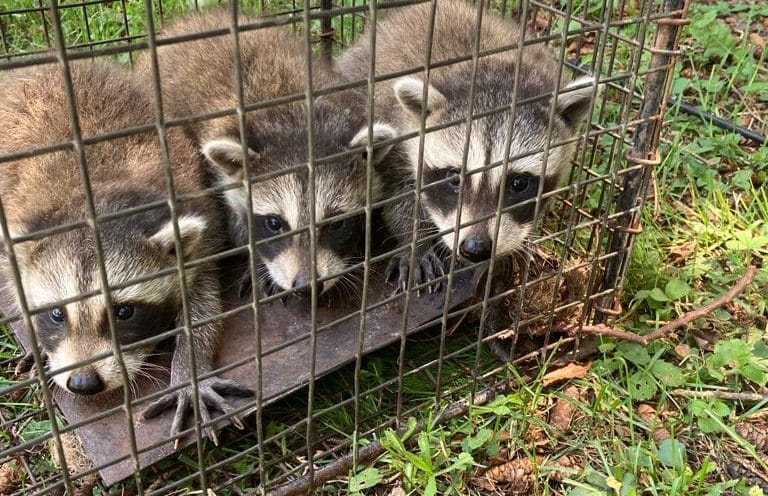
A one-way door is a small exit fitted over the hole an animal uses to get into your house. The animal pushes out to feed, cannot get back in, and the opening is then sealed. For an animal living in an attic, a wall or under a deck, it is usually a better choice than a live trap, because Ontario’s rules say a live-trapped animal has to be released within 1 km of where it was caught, and a trap does nothing about the hole.
Most people picture wildlife removal as a cage trap and a truck. Catch the raccoon, drive it out to the country, problem solved.
In Ontario it does not work that way, and it would not solve the problem if it did. The animal is only half of what is wrong. The other half is the opening in your house, and that is still there after the truck pulls away.
What is a one-way door?
It is an exit that only opens outward. You will also hear it called a one-way valve, an excluder or an exclusion device.
There are two main kinds:
- A flap door. This is a short wire tunnel with a hinged or spring-loaded flap inside, fastened over the entry hole. The animal pushes the flap open on its way out, and the flap drops shut behind it. This is the kind used for raccoons, squirrels and skunks, in a size to match the animal.
- A bat valve. Bats do not push doors. Their exits are fitted with a tube or a sleeve of netting. The bats drop out and fly off, and they cannot find their way back in through it.
The door is a tool, not the whole job. A door on one hole in a house with three holes does very little.
How does a one-way door work?
- Inspection. Every entry point is found, including the ones the animal is not using yet.
- A check for young. If there are babies that cannot walk, climb or fly, the plan changes.
- Closing the other openings. Weak spots and second entries are screened or sealed first, so the door is the only way out and there is no easy way back in.
- Fitting the door. It goes over the main entry and is fastened to the building.
- The animal leaves. Nobody chases or handles it. It goes out to feed when it normally would.
- Follow-up. The space is checked to confirm it is empty.
- Final seal. The door comes off and the last opening is closed with metal the animal cannot chew or pull apart.
Steps 1, 3 and 7 are where the job is won or lost. The animal walking out is the easy part.
One-way door vs live trap: how do they compare?
| One-way door | Live trap | |
|---|---|---|
| How the animal leaves | Walks out on its own when it goes to feed | Caught in a cage and carried out |
| Handling | None | Held in a cage until someone comes for it |
| Where it ends up | In its own home range, using another den | Released within 1 km under Ontario’s rules, so in the same neighbourhood |
| Which animal it affects | Only the one using that hole | Whatever walks in: a skunk, a neighbour’s cat or a different raccoon |
| Young in the den | Checked for first; the door waits, or the young are moved by hand | Easy to miss; a trapped mother leaves her young behind |
| The hole in the house | Sealed as the last step of the same job | Still open unless sealing is done as well |
| Best suited to | An animal living in an attic, soffit or wall, or under a deck or shed | An animal loose in a room, stuck, sick or injured |
Can a trapped raccoon or squirrel be relocated in Ontario?
Only a very short distance. Ontario’s rules for wildlife that is damaging property say a live-captured animal is to be released within 1 km of where it was caught, and within 24 hours. One that is sick, injured or orphaned goes to an authorized wildlife rehabilitator instead.
There is sense behind the limit. Moving animals can carry diseases such as rabies and distemper into new areas. And an animal dropped in strange territory does not know where the food and the dens are, and has to compete with the animals already living there.
A raccoon or squirrel let go within a kilometre of your house is still in its own neighbourhood. If the hole is open, it comes back. If it does not, another animal finds the same hole, because an attic that has been used as a den smells like one.
That is why trapping alone rarely ends a wildlife problem. What ends it is the building being closed.
Do one-way doors work for raccoons, squirrels, skunks and bats?
Yes for all four, with a different catch for each.
Raccoons
Raccoons are strong. One that is shut out of a good den may test the roof beside the door, so the door has to be solidly fastened and the nearby soffit, vents and roof edge reinforced. Kits are born in spring, mostly in April and May, and they cannot climb for weeks, so from late winter on the attic is checked for them first. Our raccoon removal page explains how a family is handled.
Squirrels
Squirrels chew, and they often have a main entry and a backup. The door works well, but only alongside chew-proof screening on every weak spot along the roofline. Grey squirrels can have young twice a year, in late winter and again in mid-summer. Our squirrel removal page covers the method.
Skunks
For a skunk under a deck, shed or porch, the door goes on the den hole, and heavy screen is buried along the rest of the perimeter so it cannot simply dig a new way in. Kits are born in late spring. In deep winter a dormant skunk may ignore the door for days, and frozen ground can delay the screening. See our skunk removal page.
Bats
Bats are never trapped. A one-way valve is the method, and timing is everything. It only works when bats are flying out each night to feed, so it cannot be done in winter, when the bats that stay are hibernating. It also waits through the maternity season, when flightless pups are in the roost. That leaves a window from mid-August to October. Seven of Ontario’s eight bat species are listed as endangered. They are protected and must not be harmed, and a professional handles the timing. Our bat removal page explains the seasons.
When does a one-way door not work?
A good company will tell you when a door is the wrong tool.
- There are young that cannot leave. A door would shut the mother out and leave the babies inside. They are moved by hand to where she can collect them, or the job waits until they can travel with her. Our guide to spring baby season lists the timing for each animal.
- The animal does not live in the building. A raccoon that raids the garbage and sleeps somewhere else has no hole to put a door on. That is fixed by removing the food.
- The animal is stuck. A squirrel at the bottom of a flue or a wall cavity cannot reach a door. It has to be brought out by hand.
- The animal is not leaving to feed. That means hibernating bats, and sometimes a raccoon or skunk in a deep cold snap.
- An entry was missed. The animal goes out through the door and back in through the hole nobody found. This is an inspection failure, not a door failure.
How long does a one-way door take to work?
It depends on how often that animal goes out.
- Squirrels go out to feed most days, so they tend to use the door within a few days. A storm or a hard cold snap can stretch that.
- Raccoons tend to use the door soon in mild weather. In a deep cold snap one may stay put for several days.
- Skunks go out most evenings in the warmer months. In winter they can stay in the den for days at a time.
- Bats leave over several nights, and the valves are left in place longer than that to be sure the whole colony is out.
The door stays on until the space is confirmed empty.
Can an animal get back in through a one-way door?
Not through a door that fits and is fastened properly. The real risk is beside the door. A raccoon may pull at the next soffit panel. A squirrel may start chewing at the next corner. That is why the other weak spots are reinforced before the door goes on.
The animal that tries hardest is a mother with young inside, which is the main reason for checking for babies first.
Can I install a one-way door myself?
You can buy a one-way door, and the device itself is simple. We still do not recommend fitting one yourself, for four reasons.
- The work is at the roofline, on a ladder or a roof, often beside an animal that does not want you there.
- Young are easy to miss. A door fitted over a den with babies inside is the worst outcome for everyone.
- Most houses have more than one entry, and finding them all takes practice.
- Bats are protected, and a valve fitted in the wrong season does real harm to them.
When is a trap the right tool?
Sometimes it is. A cage trap, or a trained person lifting the animal out by hand, makes sense when:
- An animal is loose in the living space and will not find its own way out
- An animal is stuck somewhere it cannot climb out of
- An animal is sick or injured and needs to go to a wildlife rehabilitator
- A mother and her young have to be brought out and kept together
A healthy animal is then released on site, or as close by as the situation allows and always inside Ontario’s 1 km limit, and the entry is sealed so it cannot get back in. A mother and her young are let go together so she can move them to another of her dens. What a trap should not be is the whole plan: catch it, drive it away, leave the hole.
What should I ask a wildlife removal company about its method?
- What happens to the animal? The answer should fit Ontario’s 1 km release limit, and it should include what happens to the hole.
- How do you check for young? There should be a clear answer for the season you are in.
- Do you find and close every entry, or only the one in use? Ask what material is used. It should be metal.
- Do you come back to confirm it is empty and take the door off?
- Do you use poison? The answer should be no.
- What does the quote cover? Removal, sealing and cleanup are separate pieces of work, and you should know which ones you are paying for.
What affects the cost of a one-way door job?
We do not put prices on a blog post, because houses differ too much. These are the things that move the number:
- How many entry points there are, and how high and hard to reach they are
- How much of the roofline needs screening or reinforcing
- Whether young are present, and how many visits the job needs
- How much cleanup is needed afterward
One thing to watch when you compare quotes: a trap-only quote and a door-and-seal quote are not for the same job. One removes an animal. The other removes the animal and closes the house. Our post on what drives the cost of wildlife removal goes through each factor. You get a clear, honest quote up front.
Frequently asked questions
Where do the animals go after a one-way door?
Not far. Raccoons and squirrels usually know more than one den site in their home range, such as a hollow tree, a leaf nest or a brush pile, and they move to one of those. Bats shift to another roost.
Is it cruel to use a one-way door in winter?
Used properly, it is one of the gentler options. Nobody traps or handles the animal, and it leaves on a day it was going out anyway. In a hard cold snap it simply stays in until the weather eases. The exception is bats, which are never excluded in winter. Our guide to raccoons in the attic in winter covers the winter version of the job.
Should I trap a raccoon or squirrel myself?
We do not recommend it. You end up with a frightened wild animal in a cage, and with the 1 km limit it stays in the neighbourhood. You may catch a skunk instead. In spring you may catch a mother and leave her young behind in the attic. And the hole is still open.
Not sure which method your house needs? Ask us
The Critter Guy has been family-run since 2005 and is based in Owen Sound, and we remove wildlife across Grey-Bruce the humane way: one-way doors where they fit, hands-on removal where they do not, proper sealing and no poison. If something is living in your attic, your walls or under your deck, get in touch or call 519-783-1575. A real person answers, usually Dave or Roman, and we will walk you through the plan and the quote before any work starts.