
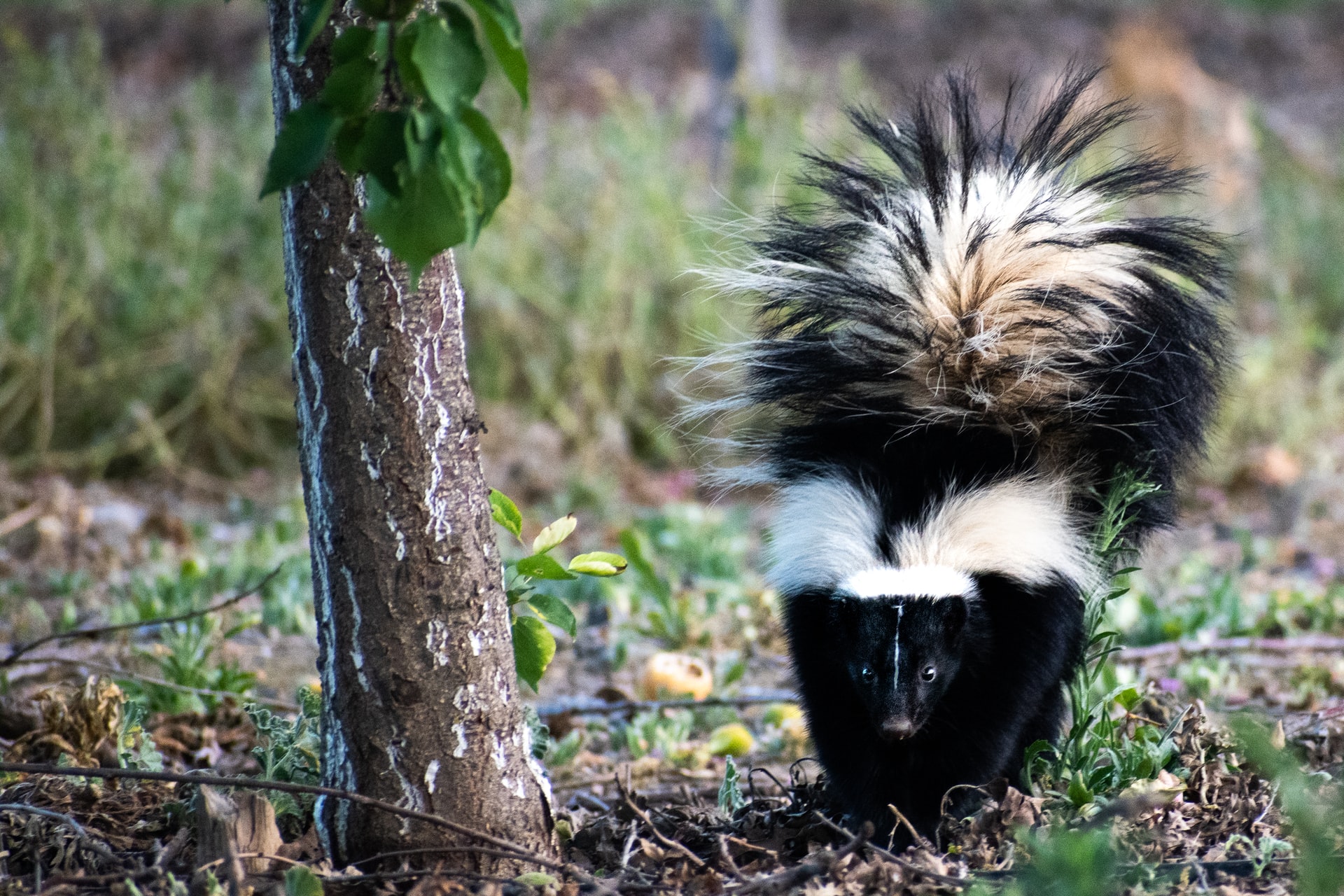
If you’re finding holes in your lawn every morning, the digger is almost always a skunk, a raccoon or a squirrel — and the real cause is usually grubs. Skunks leave cone-shaped holes. Raccoons flip back whole flaps of sod like a carpet. Squirrels dig tiny, shallow pits to bury food. From late August through fall, grubs sit shallow and animals come digging.
The good news: this damage looks worse than it is, and it tells you exactly what’s going on. Read the holes correctly and you’ll know which animal is visiting, why it picked your lawn, and what to do about it — without poison, and without a nightly battle you can’t win.
How to read the damage: what dug those holes?
Every animal digs differently. Walk the lawn in the morning and look at the shape, size and pattern of the damage. It’s like reading tracks — each species leaves a signature.
Skunks: small, neat cone-shaped holes
Skunk damage looks almost tidy. You’ll see dozens of small holes, each about the width of a loonie to a golf ball, shaped like little cones or funnels. Some people describe it as if someone walked the lawn overnight with a golf-course divot tool. Skunks have an excellent sense of smell and long front claws. They sniff out a grub, punch a quick cone into the turf, eat it, and move on to the next one. The holes are usually two to five centimetres across and shallow — occasionally larger when a skunk works one spot hard.
Skunks are also creatures of habit. If your lawn is feeding one, it will come back night after night — often on the same route, at roughly the same time. And if you’re hearing scratching or shuffling near the house after dark, it’s worth learning what skunk sounds actually sound like, because a skunk that feeds in your yard regularly may be living closer than you think.
Raccoons: sod rolled back like a carpet
Raccoon damage is messier and more dramatic. Instead of poking neat holes, raccoons use their hand-like front paws to grab the edge of the turf and peel it back in whole flaps and chunks. You’ll find sections of sod flipped over, rolled up, or torn loose and scattered — as if someone tried to re-carpet your yard at 2 a.m. and gave up halfway.
Raccoons do this because it works. Rolling back a strip of sod exposes a whole buffet of grubs at once, rather than one at a time. A single raccoon can undo a surprising amount of lawn in one night, and a mother with grown kits can do far more.
Squirrels: tiny, shallow caches (mostly harmless)
Squirrel digging looks different again, and it’s the least worrying of the three. In fall, squirrels bury acorns, walnuts and other food in small caches. The holes are shallow — a few centimetres deep — with a little loose soil pushed aside, and they appear during the day, not at night. There’s no torn turf and no cone shape, and the grass recovers almost immediately. If your “damage” is a scattering of tiny daytime pits, you can usually relax.
Skunk vs raccoon vs squirrel: quick comparison
| What you see | When it happens | Which animal | How bad is it? |
|---|---|---|---|
| Small, neat cone-shaped holes, loonie- to golf-ball-sized, dozens at a time | Overnight | Skunk | Moderate — cosmetic, repairable, but repeats nightly |
| Whole flaps of sod flipped, rolled or torn back like carpet | Overnight | Raccoon | Heaviest damage — large sections of turf disturbed fast |
| Tiny, shallow pits with loose soil, no torn turf | Daytime | Squirrel | Minimal — food caching, lawn recovers on its own |
One more clue: skunks and raccoons sometimes work the same lawn in the same week, because they’re after the same food. Mixed damage — neat cones plus flipped sod — usually means you have two different visitors, not one confused animal.
Why is this happening now? Grub season in Ontario
If the digging started in late August or September, that timing is no coincidence. The white grubs in your lawn — mostly the larvae of European chafers and Japanese beetles, plus longer-lived June beetle grubs — get a new generation hatching in mid-to-late summer, and the grubs spend the early fall feeding on grass roots just below the surface. From roughly late August through October, they are at their plumpest and shallowest of the entire year.
At exactly the same time, skunks and raccoons are bulking up for winter. Neither animal truly hibernates, but both need serious fat reserves to get through an Ontario cold season. A lawn full of fat, shallow grubs is the best restaurant in the neighbourhood, and they can smell it from a remarkable distance.
So the digging isn’t random, and it isn’t malicious. It’s normal fall feeding behaviour, happening at the one time of year when the food is easiest to reach. That’s also why deterrents alone rarely solve the problem: as long as the buffet is open, someone will keep showing up for dinner.
How do I stop animals digging up my lawn? Fix the food first
Chasing the animal without dealing with the grubs is like shooing raccoons away from an open garbage can and leaving the lid off. You need to work both sides of the problem.
Part 1: make the buffet less attractive
We’re a wildlife company, not a lawn-care company, so take this as general guidance — but it matters, because the grubs are the reason the animals are there.
- Beneficial nematodes. These are microscopic organisms, watered into the lawn, that naturally reduce grub populations. They’re the humane, no-poison route, and they’re widely available at Canadian garden centres. Timing is everything: apply from late August into September, while grubs are young, shallow and vulnerable. Water them in well and follow the package directions closely.
- Ease off the watering in late summer. Beetles prefer to lay eggs in moist, lush turf, and grubs thrive in it. A lawn kept slightly drier in late summer is simply less inviting for the next generation.
- Keep the lawn healthy going into fall. Longer grass with deeper roots tolerates some grub feeding without dying off, and it recovers from digging faster.
You don’t need a perfect, grub-free lawn — that doesn’t exist. You just need the grub population low enough that your yard stops being the best feeding spot on the street.
Part 2: deal with the animal side
While the grub numbers come down, you can make your yard less comfortable for nighttime visitors:
- Motion-activated sprinklers are the most effective simple deterrent. A sudden burst of water startles skunks and raccoons without harming them.
- Motion lights help too, though smart urban animals get used to them over time.
- Remove the extras. Fallen fruit, accessible garbage, pet food left outside — anything else edible makes the trip more worthwhile.
Be honest with yourself about what deterrents can do: their effect is modest and usually temporary. They buy time while the food source shrinks. For a deeper rundown, see our guides on natural skunk deterrents and what raccoons hate.
And check the real risk: a den on your property. The skunk tearing up your lawn every night is often not commuting from far away — it’s frequently denning under a deck, shed or porch right on the property. Walk the perimeter and look for a fist-sized gap under structures, flattened grass at an entry point, or a faint musky odour. If you find one, that changes the job from “annoying digging” to “resident animal,” and our guide to skunks under the deck covers what to do next. Fall is also sealing season — once any animals are confirmed out, closing those entry points is the single best long-term fix, and our fall wildlife-proofing guide walks through the whole checklist.
One firm rule: never use poison. It’s inhumane, it endangers pets and owls and other wildlife that eat poisoned animals, and it doesn’t fix the reason animals came in the first place.
When to call The Critter Guy
Plenty of grub-season digging resolves on its own once the food is handled. Call in help when:
- You’ve found a den under a deck, shed, porch or addition — especially in fall, when animals are choosing winter quarters. In spring and summer there may also be young inside, which changes how removal must be done humanely.
- You keep encountering the skunk itself — in the yard at dusk, near the door, or anywhere your dog might find it first.
- The damage is escalating nightly despite deterrents and grub treatment, which usually means multiple animals or a nearby den.
- You’re just not sure what you’re dealing with and want an experienced set of eyes on it.
We handle skunks and raccoons humanely — exclusion, one-way doors and prevention, never poison. One thing worth knowing: Ontario law limits wildlife relocation to within one kilometre, so “trap it and drive it away” isn’t a legal option anyway. The durable fix is removing the reason to stay and sealing the places they’d den. Every job starts with a proper look at the situation, and we give you a clear, honest quote up front.
Frequently asked questions
Will the holes in my lawn heal on their own?
Usually, yes. Skunk cones and squirrel caches fill in quickly — rake them level, press the soil down and overseed if needed. Raccoon damage takes more work: flip the sod flaps back into place, press them down firmly and water them so the roots re-knit. Fall is actually a good season for turf recovery in Ontario.
Do coffee grounds, mothballs or predator urine stop the digging?
Not reliably. Mothballs are toxic, ineffective outdoors and shouldn’t be scattered in a yard. Scent-based tricks fade within days, and a hungry animal in peak grub season will walk right past them. Motion-activated sprinklers plus grub reduction outperform every home remedy we’ve seen.
How do I know if the skunk is living under my deck or just visiting?
Look for a single well-used entry gap under the structure, a worn path or flattened grass leading to it, and a persistent musky odour near the deck. Nightly digging that starts and ends close to the house is another strong hint. If you see those signs, treat it as a den and get it assessed before sealing anything.
Is a skunk or raccoon digging in my lawn dangerous?
Not especially. Both animals want nothing to do with you and the digging itself is cosmetic. The practical risks are a startled dog getting sprayed, and the small but real disease considerations that come with any wild mammal — so don’t handle them, and keep pets in at night while the digging is active.
Torn-up lawn every morning? We can tell you exactly who’s doing it
If your lawn looks like a construction site by sunrise, don’t spend another month guessing. Get in touch or call 519-783-1575 — a real person answers, usually Dave or Roman. We’re a family-run company, working out of Owen Sound since 2005, and homeowners across Grey-Bruce have rated us 4.6 stars across 36 Google reviews — you can read their stories on our testimonials page. Humane methods only, no poison, ever — and a clear, honest quote up front.